You have two coordinates. Let's call (-1,-3) as P and (2,-2) as Q.
- First let's find the slope of the line PQ
- \(\text{Slope}= \frac{y_Q-y_P}{x_Q-x_P}=\frac{(-2)-(-3)}{(2)-(-1)}=\frac{-2+3}{2+1}=\frac{1}{3}\), we can interpret this as, for every 3 units of x, y changes 1 unit.
Now we can represent the line PQ as \(y=\frac{1}{3}x+b\), where b is the y-intercept of the line (when x=0).
To find the value of b, we can take one of the coordinates and add into our function, example:
- \(\begin{align} y &= \frac{1}{3}x+b\\ -2 &= \frac{1}{3}\cdot 2 + b\\ b &= -2 - \frac{2}{3}\\ b &= -\frac{8}{3} \end{align}\)
Then we can conclude that we can express the line PQ that passes through P and Q as \(y=\frac{1}{3}x-\frac{8}{3}\)
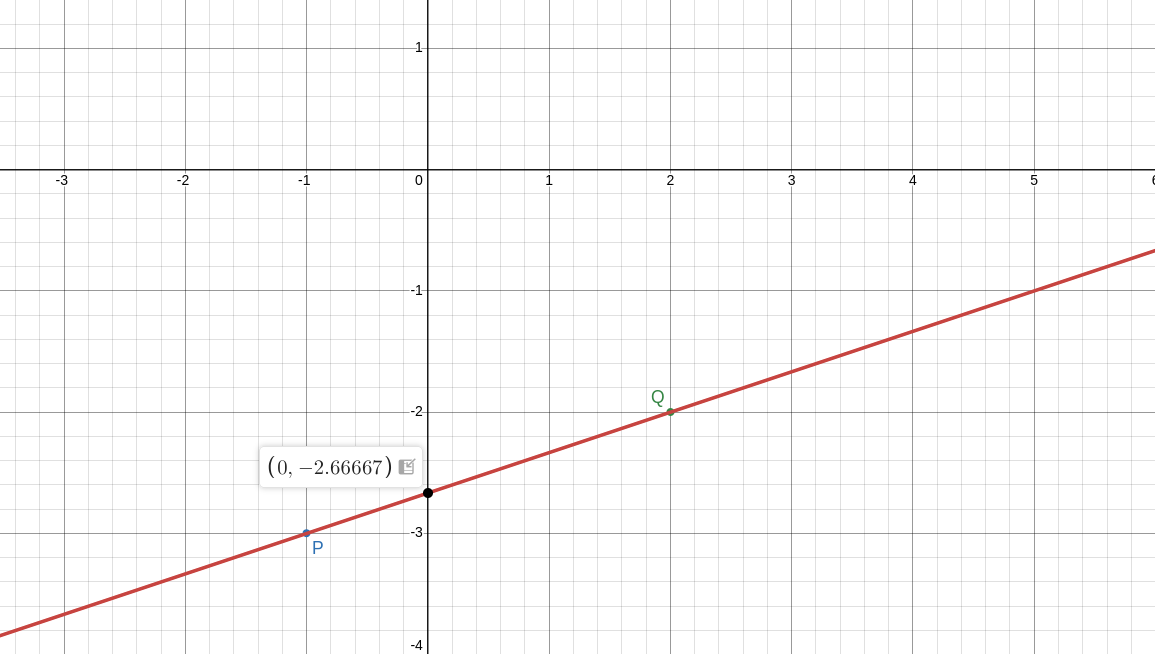
.


